
The LIV Golf era is approaching a defining moment and the financial scale behind it is impossible to ignore.
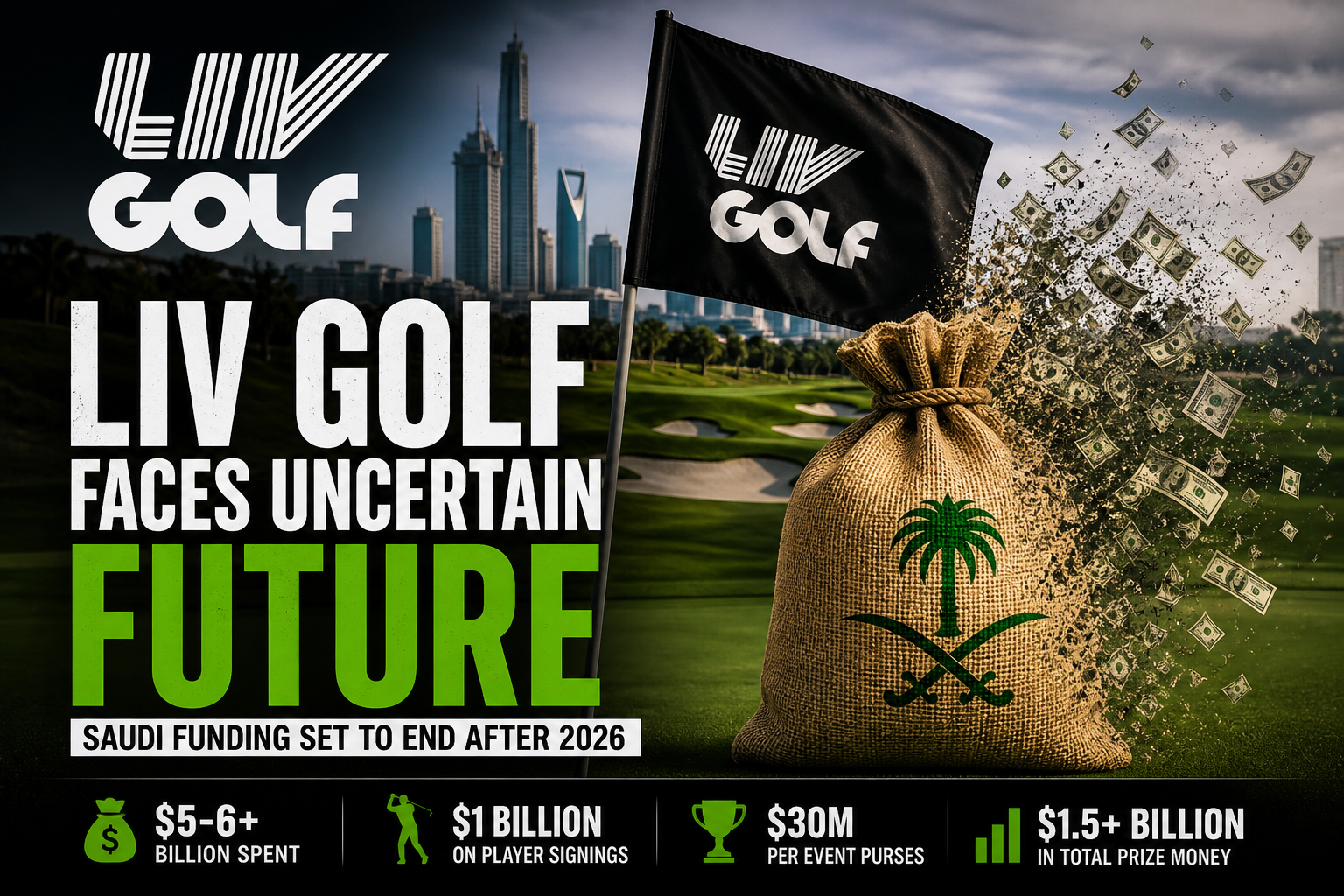
After reshaping the professional golf landscape since its launch in 2022, the Saudi-backed league is now facing a new reality. The Public Investment Fund (PIF), which bankrolled LIV’s rapid rise, is set to scale back its long term financial commitment, with funding currently confirmed through the end of the 2026 season.
That shift signals the end of the “blank cheque” phase and raises serious questions about what comes next.
From day one, LIV Golf didn’t just aim to compete with the PGA Tour it aimed to disrupt it entirely.
Backed by enormous financial power, the league invested heavily in both player recruitment and tournament prize money:
- Estimated $5–6+ billion spent since launch
- Around $1 billion allocated to signing top tier players
- Tournament purses reaching $30 million per event
- Total prize money projected to exceed $1.5 billion
It was a model built on aggressive spending, designed to fast-track legitimacy and global attention.
LIV Golf’s early success hinged on its ability to lure some of the sport’s biggest names.
Major champions and global stars including Phil Mickelson, Dustin Johnson, and Brooks Koepka made high-profile moves to the breakaway league, reportedly on massive guaranteed contracts.
The influx of elite talent gave LIV instant credibility, but it also significantly increased the cost of maintaining the competition.
Now, that financial model is evolving.
With Saudi backing set to taper beyond 2026, LIV Golf is entering a new phase one focused less on spending power and more on long term viability.
The league has already begun exploring:
- External investment opportunities
- New revenue streams and partnerships
- Structural adjustments to ensure sustainability
In simple terms, LIV must now prove it can operate as a business not just a funded project.
While LIV Golf is not shutting down, its future is far less certain than it once appeared.
The league still holds global recognition, a roster of high profile players, and a unique team based format. However, without unlimited financial backing, its ability to compete at the same level particularly against a now adapting PGA Tour remains in question.
The next two years will be critical in determining whether LIV evolves into a permanent fixture in professional golf, or becomes one of the most expensive experiments in sports history.
There’s no denying LIV Golf made an impact.
It forced change across the sport, increased player earnings, and brought unprecedented attention to the business of golf.
But the biggest question remains unanswered:
Was it sustainable or just spectacular?



Leave a Reply
You must be logged in to post a comment.